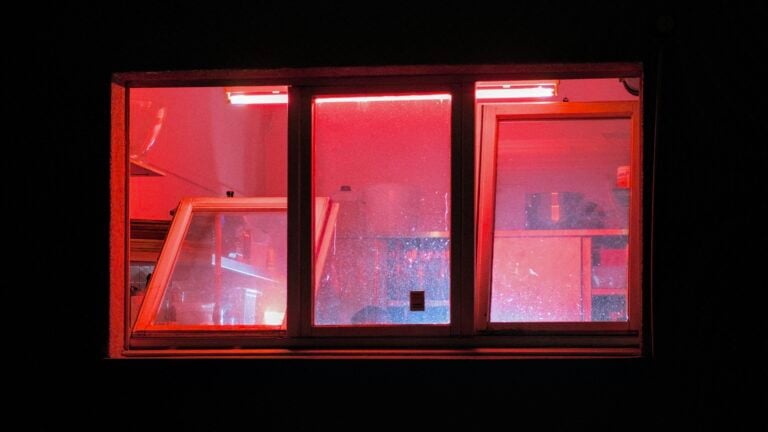
“Red light through a window, late evening. Mood before meaning.“
There is a quiet shift happening in photography.
Not loud.
Not dramatic.
But unmistakable.
“Film look” is slowly turning into a button.
Apps proudly advertise real film looks — instant, effortless, clean. One tap and an image suddenly feels nostalgic, warm, textured, finished. For many people, that’s enough.
And that’s exactly where my discomfort begins.
When effort disappears, meaning often follows
I don’t blame anyone for enjoying easy tools. Photography has always evolved alongside convenience. Auto-exposure didn’t kill photography. Autofocus didn’t either.
But something is different here.
Film look isn’t just an aesthetic — it’s a response.
To light.
To contrast.
To limitation.
To restraint.
When film becomes a preset, that context disappears. What remains is the surface of film, not its behavior.
And surface alone is fragile.
What film actually asks of you
Real film thinking forces questions, whether you want them or not:
- Where do I place my highlights?
- How much contrast can this scene hold?
- What am I willing to sacrifice to preserve mood?
- How will grain interact with tone, not decorate it?
This is why tools like Dehancer feel fundamentally different. They don’t promise speed. They model film as a system. Grain grows with exposure. Highlights compress. Color shifts under stress.
It’s not romantic.
It’s disciplined.
And discipline rarely survives in a one-click culture.
The uncomfortable truth
This is the part we rarely say out loud.
Most people don’t care how an image is made.
They don’t care if a film stock is accurately modeled.
They don’t care whether grain behaves correctly or highlights roll off naturally.
They care if it looks good now.
That doesn’t make them wrong — but it does mean photographic craft will never be mainstream again.
And maybe it never truly was.
Why this still hurts
It hurts because film language is being flattened.
Subtle negatives are called “boring.”
Neutral color becomes “cold.”
Restraint is mistaken for a lack of style.
What once took time to understand is now summarized as:
warm shadows + soft contrast + fake grain.
That simplification doesn’t just change taste — it erodes visual literacy.
This is where the slippery slope lives
Not in the tools themselves.
But in the message they quietly send:
You don’t need to understand this to use it.
Once that idea takes hold, craft becomes optional. And when craft becomes optional, it slowly disappears from the conversation.
That is the slope.
Convenience tools like Snapseed aren’t the enemy. They’re simply honest about what they offer: speed, accessibility, familiarity.
The problem begins when their results are mistaken for understanding.
The quiet relief nobody talks about
Photography has always split in two directions:
- fast and accessible
- slow and intentional
They don’t compete. They coexist.
The people who care about film craft don’t shout.
They revisit images. They print. They notice small differences that compound over time.
Film look doesn’t survive because it’s popular.
It survives because it’s practiced.
A final thought
If film look has become a button, then choosing not to press it is already a statement.
Not against technology.
Not against progress.
But for intention.
And intention — unlike trends — doesn’t expire.