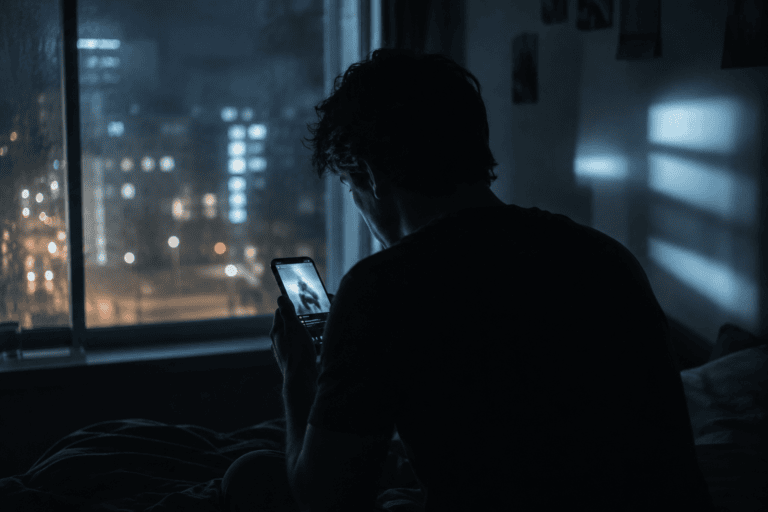
A video moves through social media late at night.
Someone watches it in bed with the sound low so nobody else wakes up.
The face seems right at first.
Then something feels slightly off.
Not enough to immediately dismiss it.
Just enough to watch it again.
By morning thousands of people are arguing over whether it really happened.
A few years ago this would have felt extraordinary.
Now it feels like part of the week.
That may be the strangest change.
Not that false things exist.
They always have.
But that doubt now arrives almost instantly.
A photograph no longer settles anything for very long.
A recording no longer fully proves someone was there.
Even a familiar voice can create a moment of hesitation before belief catches up.
Most people barely notice these moments.
But they build up over time.
A teacher reads a student essay and cannot fully tell where it came from.
Not because it is bad.
Because it sounds strangely finished.
The sentences move forward without hesitation. Everything connects a little too neatly. There is no place where a thought seems to stop and search for itself.
Elsewhere, a photograph shared thousands of times turns out not to be real.
The correction appears quietly.
Most people never see it.
And even among those who do, something has already happened.
A public figure denies a recording.
Ten years ago the denial itself might have sounded absurd.
Now people pause before deciding.
Sometimes longer than they want to.
The hesitation is no longer rare.
It appears in classrooms, offices, family chats, ordinary conversations between friends.
People are becoming careful with reality itself.
A strange thing happens after enough of these moments.
People become more careful with what they see.
Not all at once.
The change is smaller than that.
Someone watches a video and immediately wonders how easily it could be manipulated.
Someone reads a dramatic claim online and waits before believing it.
A person hears shocking news and checks several places before accepting that it happened.
None of this feels important by itself.
But repeated often enough, it changes the tone of daily life.
A quiet tension enters ordinary attention.
Not panic.
Not paranoia.
Just uncertainty becoming routine.
And after a while that uncertainty expands beyond screens.
People carry it into conversations.
Into friendships.
Into the way they listen to each other.
Trust becomes slower.
Some people retreat into smaller circles where things feel more recognizable.
Others stop trying to know what is true at all. They move from reaction to reaction, following whatever feels convincing in the moment.
Beneath all this sits another kind of exhaustion.
Not caused by information, but by never fully knowing where reality ends and performance begins.
People need to feel that others are seeing the same world they are.
Not perfectly.
But enough to remain connected to each other.
That is becoming harder.
Someone sends a video to a friend without knowing if it is real.
Two people witness the same event and leave with entirely different understandings of what happened.
Trust is lost.
Connections weaken.
A world once shared no longer feels shared in the same way.
People retreat into smaller worlds instead.
Smaller circles.
Smaller sources.
Smaller realities that feel safer to hold onto.
People become careful with each other.
Not openly.
Quietly.
Beneath that caution sits fatigue.
Not from information alone.
From constantly having to decide what to believe.
After a while, some people stop trying altogether.
Not because they no longer care.
Because certainty itself begins feeling too far away.
And when that feeling lasts long enough, something else weakens too.
The sense that other people are still living in the same reality you are.
And this is where artificial intelligence enters the wound more deeply.
Not as the beginning of it.
As the place people turn to when the world outside feels too difficult to meet directly.
A screen answers without disappointment.
A generated voice stays patient.
A story can always become what we need it to be.
A companion can appear without the risks real people bring.
For someone already tired, this can feel like relief.
No argument.
No rejection.
No waiting for another human being to understand.
But relief is not always the same as return.
Sometimes it is only a softer way of leaving.
And this is where something else begins.
Not because we are foolish.
But because real life has become too sharp for many of us to touch without pain.
So we move toward what responds easily.
What adapts.
What reflects us back without asking too much.
And for a while, it feels almost human.
Almost enough.
But something inside us knows.
A small inner voice.
The feeling that something answered, but was never truly there.
Maybe this is why so many of us feel exhausted.
Not from information, but from the growing distance between us and real shared living.
A conversation held without performance.
A presence that does not scream for attention.
These things are becoming harder to find.
Not because the world is about to correct itself.
There is no sign of that.
The movement in the other direction is still accelerating.
More simulation.
More performance.
More realities shaped to fit desire, fear, identity, and reaction.
But somewhere beneath all of it, something quieter may still remain.
A memory of what it feels like to truly meet another person.
To stand inside reality again.
To experience something that does not need to be optimized, filtered, performed, or consumed.
Something in us has never forgotten.